
Vallor vs.
Vallor vs Zip: Contract Intelligence vs Procurement Orchestration
Zip orchestrates the procurement request. Vallor reads what is inside the contracts those requests produce. Here is where each fits, and why teams often run both.
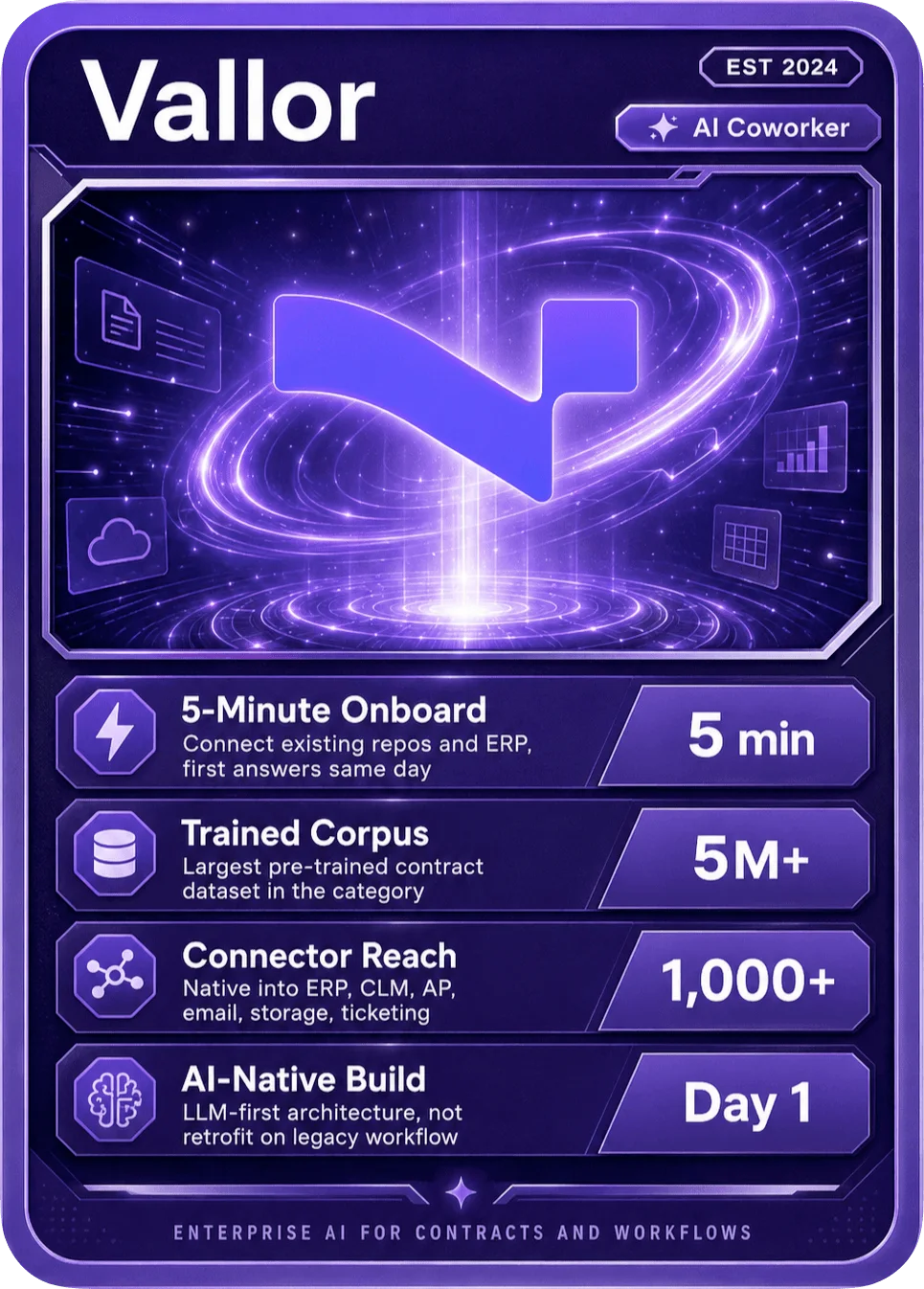
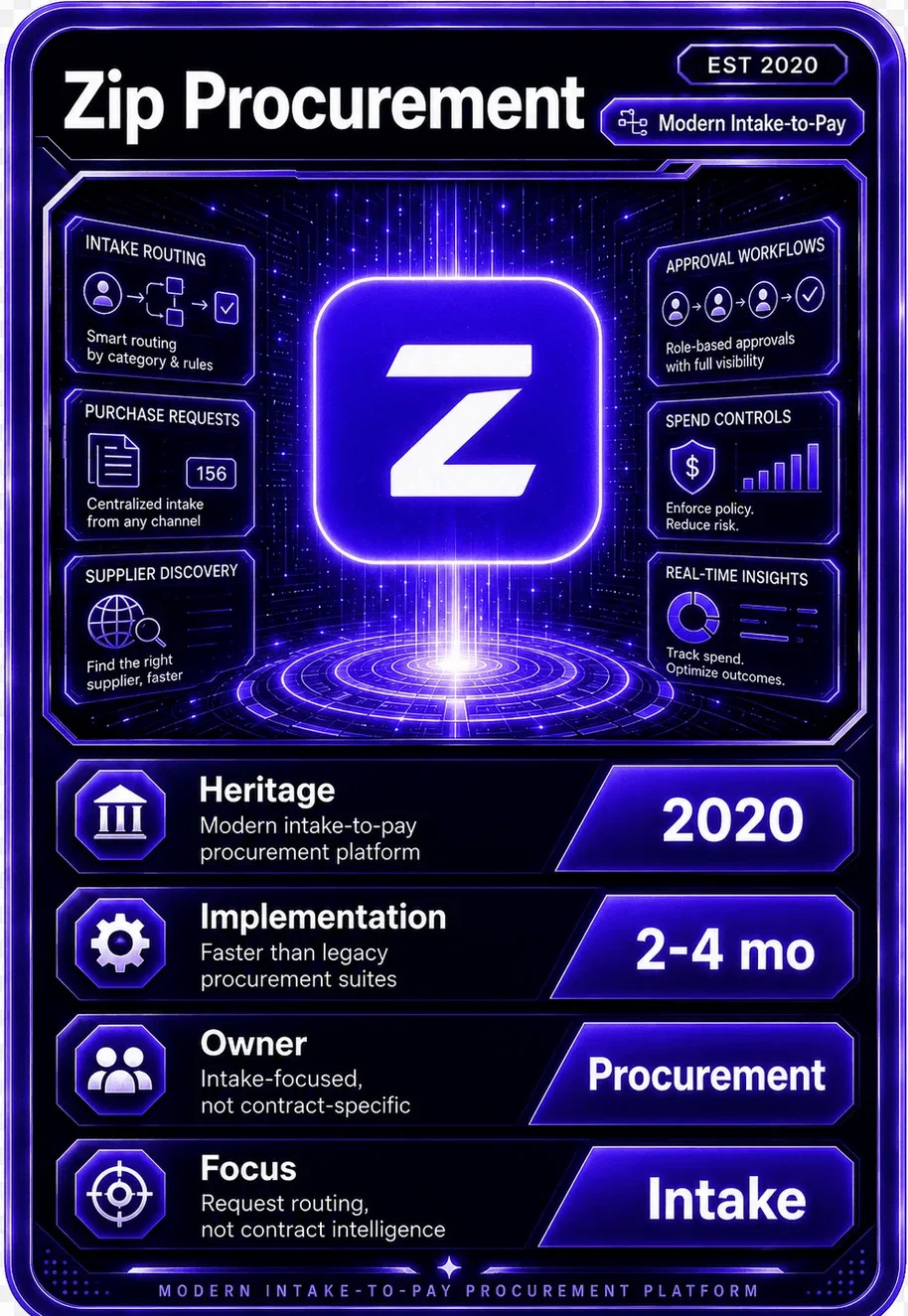
Zip and Vallor solve different halves of the same problem. Zip orchestrates the procurement request: intake, approvals, vendor onboarding, and routing to your P2P system. Vallor is the contract intelligence layer that reads what is actually inside the agreements those requests produce: terms, obligations, renewals, and leakage. Most procurement teams that run Zip still need a way to know what their signed contracts say. That is the gap Vallor fills.
- Choose Zip when the pain is the front door: messy intake, slow approval routing, and vendor onboarding that loops in too many stakeholders by hand.
- Choose Vallor when the pain is contract visibility: nobody can answer what is owed, what auto-renews next quarter, or where spend is leaking across your signed agreements.
- They are more complementary than competitive. Zip runs the workflow that creates contracts. Vallor reads the contracts and watches the obligations after signature.
- Zip launched AI Contract Orchestration in April 2026, but it positions itself as a workflow layer, not a contract repository or system of record for terms (Zip, “AI CLM vs. contract orchestration”).
- Run both if you have intake chaos and contract blindness. Run Vallor alone if your intake is fine and the real gap is knowing what is in the agreements you already signed.
Side-by-side comparison
| Dimension | Vallor | Zip |
|---|---|---|
| Category | AI coworker for contract intelligence. Reads every agreement and answers with citations across your stack. | Procurement orchestration platform. Intake-to-procure workflow that routes requests to your P2P system. |
| Core job | Understand what is inside signed contracts: terms, obligations, renewals, risk, and value leakage. | Move the procurement request forward: intake, approvals, vendor onboarding, spend routing. |
| Contract data depth | Reads the full document. Extracts clauses, obligations, caps, notice windows, and price terms with source citations. Win | Stores contract documents and metadata as workflow artifacts. Not a system of record for contract terms. |
| Obligations and renewal monitoring | Tracks obligations and renewal windows continuously and flags them before the notice date passes. Win | Surfaces renewals as data-backed workflow events tied to spend, mainly for contracts that ran through Zip. |
| ERP and CLM integration approach | Sits on top of existing systems with 1,000+ pre-built connectors across ERP, CLM, storage, and email. | Pre-built connectors to ERPs (NetSuite, Oracle, SAP), P2P (Coupa), and CLM (Ironclad) to orchestrate around them. |
| Where it lives | In email, Teams, and Slack. You ask a question and get a cited answer where you already work. | Its own app, with native Slack and Teams notifications for approvals and intake requests. |
| Deployment | Live in minutes. Connect your contracts and systems and get first answers the same day. Win | No-code, but typically 4 to 8 weeks to configure intake, approval logic, and integrations (industry reports). |
| Pricing model | Priced to cost a fraction of one FTE, no large implementation services motion. | Custom subscription, roughly tiered by users and modules. Industry estimates put it near $40K to $120K per year. |
| Primary owner | Procurement, legal, finance, and sales who need answers across active and legacy contracts. | Procurement operations who own the request pipeline and vendor onboarding process. |
Best-fit profile
Choose Vallor when…
- You can route a purchase request fine, but nobody can tell you what your signed contracts actually say.
- You are losing money to auto-renewals, missed notice windows, unclaimed rebates, or SLA credits buried in the agreements.
- Your contracts live across a CLM, ERP, shared drives, and email, and you need one place to ask questions with citations.
- You want answers across active and legacy contracts in days, not after configuring a workflow project.
- Legal and finance need to act on contract terms, not just track where a request is in the approval queue.
Choose Zip when…
- Your intake is chaos. Requests come in over email, Slack, and hallway conversations with no single front door.
- Approval routing is the bottleneck. You need parallel approvals across legal, security, finance, and IT instead of slow sequential reviews.
- Vendor onboarding is manual and you want security reviews, tax validation, and compliance checks triggered automatically before a human looks.
- You want to orchestrate spend in front of an existing P2P system like Coupa, Ariba, or NetSuite without ripping it out.
- Your primary goal is controlling the request-to-PO pipeline, and contract reading is a secondary concern you can solve later.
How Vallor wins
Reads the contract, not just the request
Zip orchestrates the workflow that produces a contract and then matches it to spend. Vallor reads the document itself: every clause, cap, obligation, and renewal date, with a citation back to the source line. Zip explicitly calls its contract layer a workflow boundary, not a repository or system of record for terms.
Zip, “AI CLM vs. contract orchestration” (zip.com/blog, 2026).Covers contracts that never touched Zip
Zip's renewal and compliance intelligence works best on agreements that ran through its intake. Vallor reads your whole portfolio, including the legacy contracts signed years before any orchestration tool existed. That backlog is usually where the leakage and missed renewals hide.
Zip platform overview; observed Vallor onboarding across legacy portfolios.Answers where you already work
Both tools touch Slack and Teams, but Zip uses them to push approvals and intake prompts. Vallor answers contract questions in email, Teams, and Slack with cited responses, so you do not open a separate app to find out what a contract says.
Vallor product; Zip native Slack and Teams integration docs.Minutes to first answer, not weeks to configure
Zip is no-code but still needs intake forms, approval logic, and integrations configured, which industry reports put at 4 to 8 weeks. Vallor connects to existing contracts and systems and returns useful answers the same day, because it reads what is already there instead of defining a new workflow.
Industry implementation reports (Brex, ProcureDesk 2026); observed Vallor onboarding timelines.Most teams do not migrate off Zip to Vallor, because they do different jobs. The common pattern is to run both: keep Zip for intake, approval routing, and vendor onboarding, and add Vallor as the contract intelligence layer that reads the agreements Zip's workflows produce and the legacy contracts Zip never saw. Vallor connects to the same ERP and storage systems Zip already touches, so there is no rip-and-replace. If your intake is already fine and the real pain is contract visibility, you can run Vallor on its own. Start by pointing Vallor at your signed-contract repository, then compare what it surfaces against what Zip reports post-signature. The overlap is small, and the gap is usually obvious.
See also
FAQ
Does Vallor replace Zip?
Zip launched AI Contract Orchestration. Isn't that the same as Vallor?
Can Vallor read contracts that did not go through Zip?
Do Zip and Vallor integrate with the same systems?
Which should procurement buy first?
Last updated: 2026-06-10. Part of Vallor's comparison library.
See the difference yourself
Compare Vallor on your own contracts.
Book a 30-minute demo and see how Val reads, redlines, and flags risk, side by side with whatever you run today.