
Vallor vs.
Vallor vs Ironclad: AI Coworker vs Legacy CLM
Vallor vs Ironclad: AI Coworker vs Legacy CLM compared across implementation time, AI depth, procurement fit, legal workflow fit, and enterprise readiness.
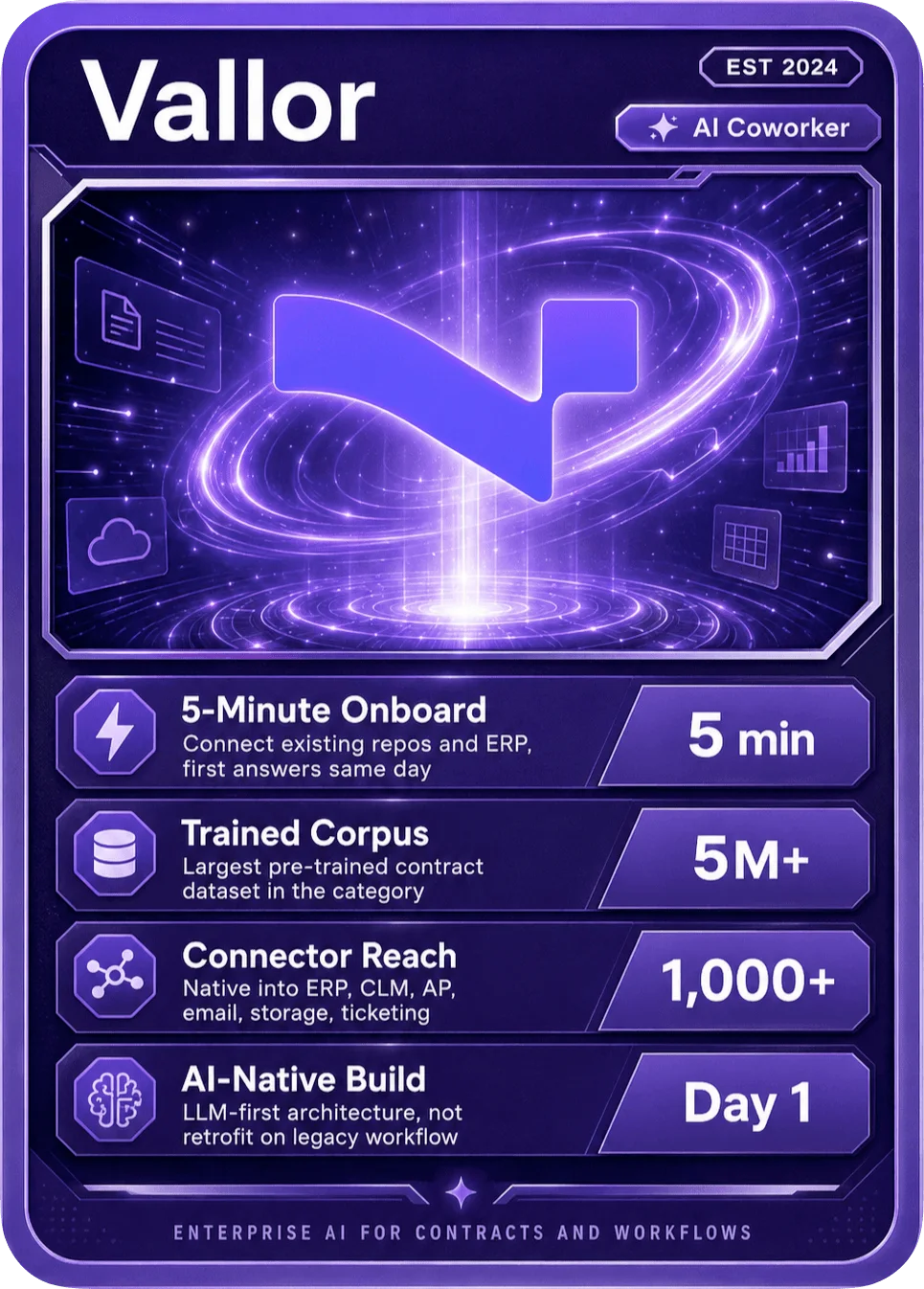
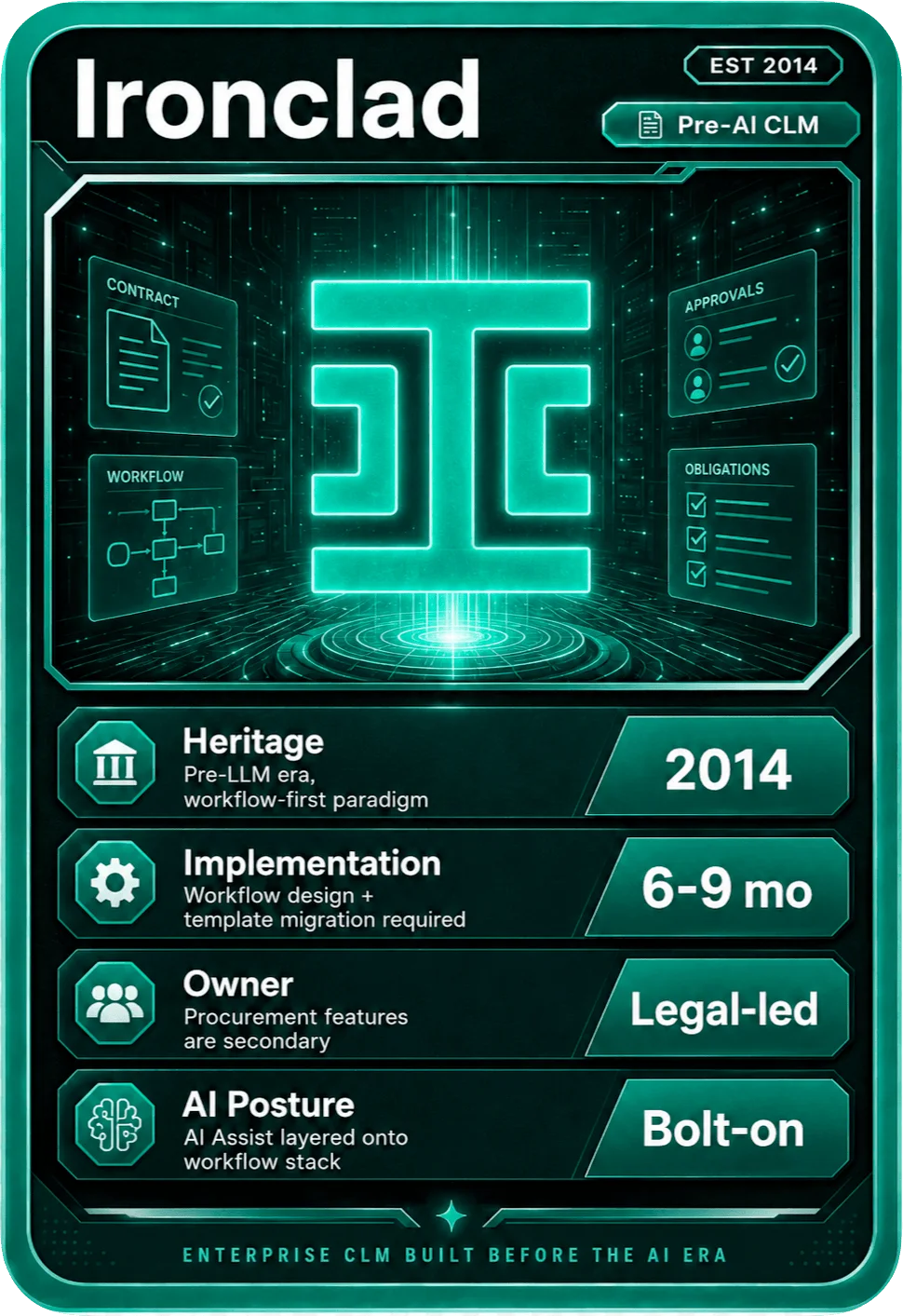
Vallor is best when procurement and legal need answers and obligations across their existing stack on day one. Ironclad is best when a legal-led team wants a mature CLM workflow environment for intake, approvals, and contract records and can absorb a 6 to 9 month implementation.
- Choose Vallor when you need contract answers, obligation monitoring, and procurement workflows without a long implementation project.
- Choose Ironclad when legal-led workflow standardization (intake, templating, approval routing) is the center of gravity.
- Ironclad was built in 2014 as a legal-workflow CLM; AI features were added later. Vallor is AI-native from day one.
- Most material decisions hinge on time-to-value and where the team owns the contract function (legal-led vs procurement-led).
Side-by-side comparison
| Dimension | Vallor | Ironclad |
|---|---|---|
| Primary model | AI coworker that reads contracts, watches systems, answers questions with citations, and triggers follow-up work. | Legal-led CLM with workflow, repository, e-signature, and bolt-on AI features. |
| Architecture | AI-native. Built around retrieval, reasoning, and bounded autonomy from day one. Win | Workflow-native. Built pre-LLM era (2014). AI features added incrementally on top. |
| Implementation | First useful answers in minutes from existing repositories. No re-papering. Win | Typical enterprise deployment: 6 to 9 months. Workflow design, template migration, training all required. |
| Best-fit owner | Procurement-first (with strong legal + finance coverage). Cross-functional by design. | Legal-led. Procurement features exist but are not the center of gravity. |
| AI capabilities | Contract-specific reasoning, obligation execution, portfolio queries, playbook redlining. Citations on every answer. Win | AI Assist (review, search, summarization) layered onto the workflow. Capabilities expanding but rooted in workflow paradigm. |
| API and integrations | 1,000+ pre-built connectors. Reads from existing CLM, storage, email, ERP without migration. Win | REST API available. Workflow-shaped, less suited to portfolio-wide reads. Many integrations require custom development. |
| Commercial posture | Priced as service-as-software. Designed to cost a fraction of one FTE; no large services motion. | Enterprise quote-based. Confirm license, services, AI usage, and integration costs separately. |
Best-fit profile
Choose Vallor when…
- You want contract answers across your portfolio in days, not after a 9-month workflow project.
- Procurement, legal, finance, and sales all need to query contract data with citations.
- You already have a CLM or storage system and do not want to re-paper everything.
- Obligation tracking and renewal management matter more than perfecting the intake form.
- You want AI capabilities that ship as outcomes (work done), not as another assistant tab.
Choose Ironclad when…
- Your legal team is the primary owner of contracts and wants a workflow tool of record.
- Standardizing intake forms, templates, and approval chains is the top operational priority.
- You can absorb a 6 to 9 month implementation and the services motion that comes with it.
- You prefer a mature legal-tech vendor with category recognition (Gartner Magic Quadrant Leader).
- Your AI needs are primarily review and search inside the workflow, not portfolio-wide reasoning.
How Vallor wins
5-minute onboard vs 6-9 month implementation
Vallor connects to your existing contracts and ERP and returns first useful answers in minutes. Ironclad's enterprise deployments typically run 6 to 9 months and require workflow design and template migration. Gartner finds 30 to 50 percent of CLM implementations fail at adoption.
Gartner CLM research 2024-2026; observed Vallor onboarding timelines.AI-native architecture vs AI bolt-on
Vallor was designed in the LLM era around retrieval, reasoning, and bounded autonomy. Ironclad was designed in 2014 around contract workflow; AI Assist features were layered on later. The two architectures lead to different defaults.
Portfolio-wide reasoning with citations
Vallor answers questions across the full portfolio (e.g. 'which contracts cap liability above 2x?') with citations back to the source clause. CLM-native search returns documents that match a keyword. Procurement, legal, finance, and sales all need the former.
Cross-functional by default
Vallor is built for procurement, legal, finance, and sales to share a single contract intelligence layer. Ironclad's center of gravity is legal-led workflow; cross-functional adoption is possible but works against the tool's default shape.
Most Vallor customers coming from Ironclad keep Ironclad for intake, templating, and workflow during the transition. Vallor reads from Ironclad's repository (and any other contract sources) to deliver obligation tracking, portfolio queries, and AI-native review in parallel. Teams that want to fully cut over typically do so 6 to 12 months later, once the day-to-day work has moved to Vallor.
See also
FAQ
Does Vallor replace Ironclad?
How does Ironclad's AI Assist compare to Vallor?
Is Ironclad more mature than Vallor as a CLM?
Which is better for procurement teams specifically?
Which is better for legal teams specifically?
What does Ironclad cost vs Vallor?
Last updated: 2026-05-22. Part of Vallor's comparison library.
See the difference yourself
Compare Vallor on your own contracts.
Book a 30-minute demo and see how Val reads, redlines, and flags risk, side by side with whatever you run today.