
Vallor vs.
Vallor vs Harvey: Legal AI Assistant vs Contract Ops
Harvey is a legal AI assistant for research, drafting, and diligence. Vallor is an AI coworker for the contract portfolio, renewals, obligations, and vendor risk. Different categories, honest map.
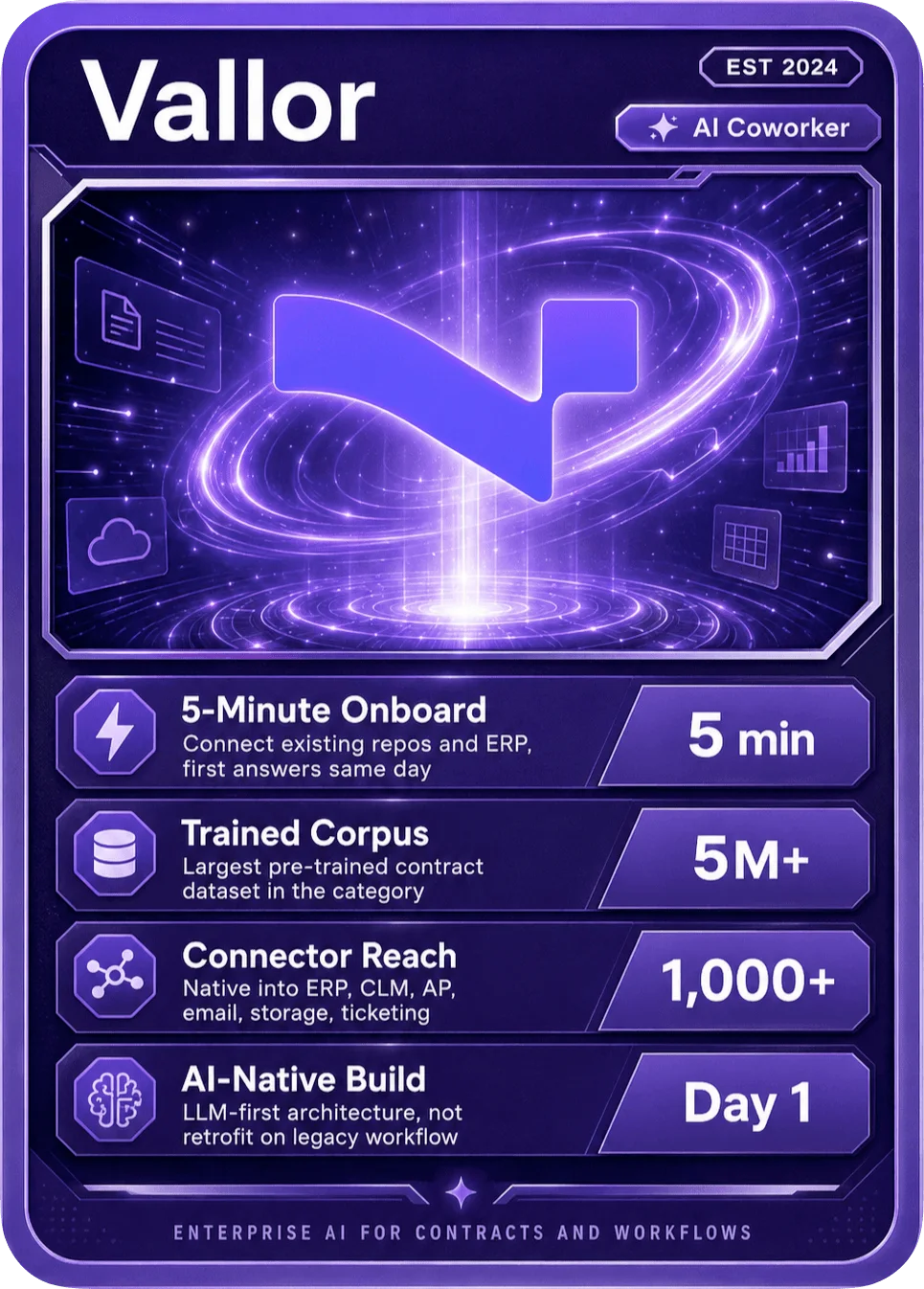

Harvey and Vallor sit in different categories, so the honest answer is usually both. Harvey is a legal AI assistant built for the work product of lawyers, research, drafting, diligence, and matter workflows, and it is strongest inside law firms and large in-house legal teams. Vallor is an AI coworker for the contract portfolio itself, the renewals, obligations, vendor risk, and commercial terms that procurement, finance, and legal operations have to act on. Pick Harvey to do legal work faster. Pick Vallor to run the contracts you already signed.
- Choose Harvey when lawyers need to research, draft, and review across legal corpora, M&A data rooms, and matter workflows, especially in a law firm or large legal department.
- Choose Vallor when procurement, finance, and legal ops need answers, obligations, and renewals across the contracts already in your ERP, CLM, and drives, with citations and no implementation project.
- Harvey reasons over legal research sources and the documents you load. Vallor reasons over your live contract portfolio wired into business systems through 1,000+ pre-built connectors.
- Harvey is enterprise sales only, with seat minimums, annual contracts, and implementation and training services. Vallor onboards in 5 minutes and returns first answers the same day.
- These are not the same purchase. Many teams run Harvey for legal work product and Vallor for the contract operations layer underneath it.
Side-by-side comparison
| Dimension | Vallor | Harvey |
|---|---|---|
| Category and scope | AI coworker for contract operations and commercial intelligence. Answers, obligations, renewals, and vendor risk across the live portfolio. | Legal AI assistant for legal work product. Research, drafting, document analysis, diligence, and matter workflows. |
| Who it is built for | Procurement, finance, legal operations, and sales who have to act on signed contracts and spend. | Lawyers. Built first for Am Law 100 firms, now extended to large in-house legal teams. |
| Data it reasons over | Your contracts plus the business systems around them, ERP, AP, CRM, CLM, email, and drives, connected through 1,000+ pre-built connectors. Win | Legal research corpora and the documents you load (Vault, iManage, SharePoint, plus sources like LexisNexis). |
| Post-signature management | Core purpose. Tracks obligations, renewal and notice windows, price caps, SLAs, and rebates, then triggers follow-up work. Win | Not the focus. Strong on pre-signature analysis and drafting, not ongoing obligation or renewal monitoring across a portfolio. |
| Where it lives | In email, Teams, and Slack, where the business already works. You ask, it answers with citations. | In the Harvey web app, with drafting that reaches into Word and Outlook for legal authoring. |
| Deployment and access | Onboards in 5 minutes from existing contracts and connectors. First useful answers the same day. Win | Enterprise rollout with implementation services, training, and onboarding for the firm or department. |
| Procurement and commercial features | Built in, renewal exposure, vendor risk, savings leakage, SLA credits, and obligation tracking tied to spend data. Win | Not a procurement tool. Contract analysis serves legal review and diligence, not spend and renewal operations. |
| Legal research and drafting depth | Reads and reasons over contracts, but not a legal research or litigation drafting engine. | Deep. Case law, regulatory and tax research, pleadings, briefs, memos, and firm-template drafting. |
| Pricing model | Designed to cost a fraction of one FTE. No large services motion to reach first value. | Enterprise quote only. Seat minimums (commonly 25 to 50), annual contracts, plus implementation and training. No self-serve. |
Best-fit profile
Choose Vallor when…
- You need to know what is in your signed contracts and act on it, renewals, obligations, price caps, and vendor risk, not draft new ones.
- Procurement or finance owns the problem and needs a CFO-ready number on renewal exposure and savings leakage.
- Your contracts live across ERP, CLM, email, and drives, and you want answers across all of them without a migration.
- You want value this quarter, not after an implementation and training rollout.
- You want the answer to come to you in email, Teams, or Slack, with a citation back to the clause.
Choose Harvey when…
- You are a law firm or large legal department and the core job is legal work product, research, drafting, briefs, and memos.
- You run high-volume M&A or diligence and need cross-document synthesis across large data rooms (Vault is built for this).
- Your lawyers need real legal research across case law, regulatory, and tax sources, not just contract reasoning.
- You want firm-template drafting inside Word and Outlook, structured for partner-track review.
- You need complex matter workflow automation with conditionals, classification, and role-based sharing across a legal team.
How Vallor wins
Built for the portfolio, not the matter
Harvey accelerates the legal work in front of a lawyer. Vallor reasons over the whole contract portfolio you already signed, so a renewal in 47 days or an uncapped liability surfaces before it costs you, not when someone opens the file.
Harvey platform overview (harvey.ai/platform); GC AI Harvey review 2026.Wired into business systems, not just documents
Harvey integrates with document and research systems like iManage, SharePoint, and LexisNexis. Vallor connects to the systems where commercial context lives, ERP, AP, CRM, and CLM, through 1,000+ pre-built connectors, so answers reflect spend and obligations, not only the text of a document.
Harvey integrations (harvey.ai/platform); Vallor connector library.Live in minutes, not after a rollout
Harvey is enterprise sales with implementation services, training, and onboarding. Vallor onboards in 5 minutes from existing contracts and connectors and returns first useful answers the same day.
Costbench Harvey pricing 2026 (implementation $5K to $100K+, training per user); observed Vallor onboarding timelines.Procurement and finance get a seat
Harvey's design constraint is the lawyer. The GC AI review notes it leaves day-to-day business work underserved. Vallor is built for the procurement, finance, and legal-ops owners who track renewals, vendor risk, and savings leakage tied to real spend data.
GC AI Harvey review 2026 (in-house fit and scope notes).This is rarely a rip and replace, because Harvey and Vallor do different jobs. The common pattern is to run both. Keep Harvey for legal work product, research, drafting, and diligence inside the legal team. Point Vallor at the contracts you have already signed by connecting your ERP, CLM, drives, and email, then let it handle the operational layer, obligations, renewals, vendor risk, and answers with citations for procurement and finance. Start with one workflow, usually renewals or obligation tracking, and measure the exposure it catches in the first week.
See also
FAQ
Is Harvey a competitor to Vallor?
Does Vallor do legal research and drafting like Harvey?
Can Harvey track renewals and obligations across my contracts?
How do the pricing and rollout compare?
What data does each one need to start?
Last updated: 2026-06-10. Part of Vallor's comparison library.
See the difference yourself
Compare Vallor on your own contracts.
Book a 30-minute demo and see how Val reads, redlines, and flags risk, side by side with whatever you run today.