January 25, 2026
Procurement Leaders AI Category Startegy Playbook
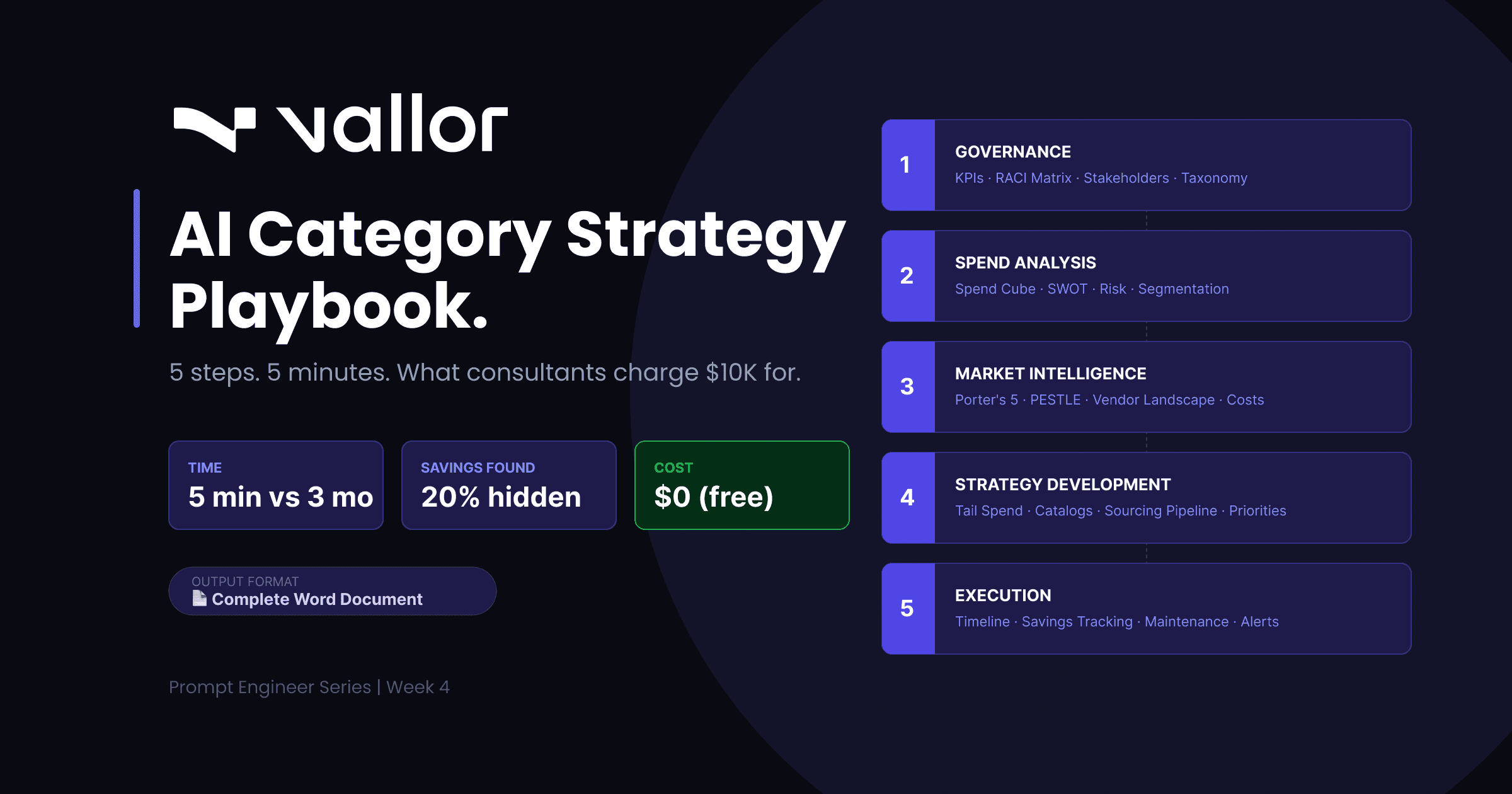
What consulting firms take 3-4 months to build, this prompt generates in 5 minutes. Complete with frameworks, market intelligence, and execution plans.
The AI Category Strategy Playbook Prompt
Consulting firms charge five figures and take 3-4 months to build a category strategy. Most procurement teams either pay up or skip it entirely. Both options are bad. We built a prompt that generates a complete, deeply researched category strategy in a Word document in about 5 minutes.
Week 4 of our Prompt Engineer series dropped and it is the most requested one yet. The prompt covers everything a consultant would deliver: spend analysis, SWOT frameworks, Porter's Five Forces, vendor landscapes, and full execution timelines. All generated with enterprise-grade accuracy.
The 5-Step Framework
The playbook walks through five phases that mirror exactly how top procurement teams build category strategies.
Step 1 is governance. You set the rules and define who plays. The AI drafts KPIs and a governance plan from your data source, covering definition and taxonomy, category scope, stakeholder identification, roles and responsibilities, and a full RACI matrix.
Step 2 is spend analysis. You cut spend by supplier, category, business unit, and risk. The AI builds the spend cube, runs vendor profiling, contract analysis, payment term analysis, risk analysis, SWOT, maturity assessment, and category segmentation. This is the step where hidden patterns surface.
Step 3 is market intelligence. You size the prize and find where leverage exists. The AI runs a market overview, trends analysis, vendor landscape mapping, industry cost structure breakdown, PESTLE analysis, and Porter's Five Forces. Quick wins and strategic bets become clear.
Step 4 is strategy development. You consolidate low-value, high-noise spend. The AI clusters the tail and proposes catalogs and rate cards. It maps business requirements to category goals, runs opportunity assessments, builds the strategy plan, identifies initiatives, and creates a sourcing pipeline with prioritization.
Step 5 is execution. You plan the work, measure savings, and keep it current. The AI builds the execution timeline, creates a detailed execution plan, sets up savings tracking, and establishes maintenance and revision schedules. It runs the checklist and alerts on drift.
Why This Matters
This is not theory. This is what happens when you combine real procurement frameworks with AI that knows how to apply them. Teams using this playbook are finding 20% in hidden savings, running faster procurement cycles, getting better vendor responses, and producing cleaner strategies.
Get the full Prompt free: https://vallor-ai.notion.site/Category-Strategy-2434c4604eb8801a94b8c8d719c54753?source=copy_link

